

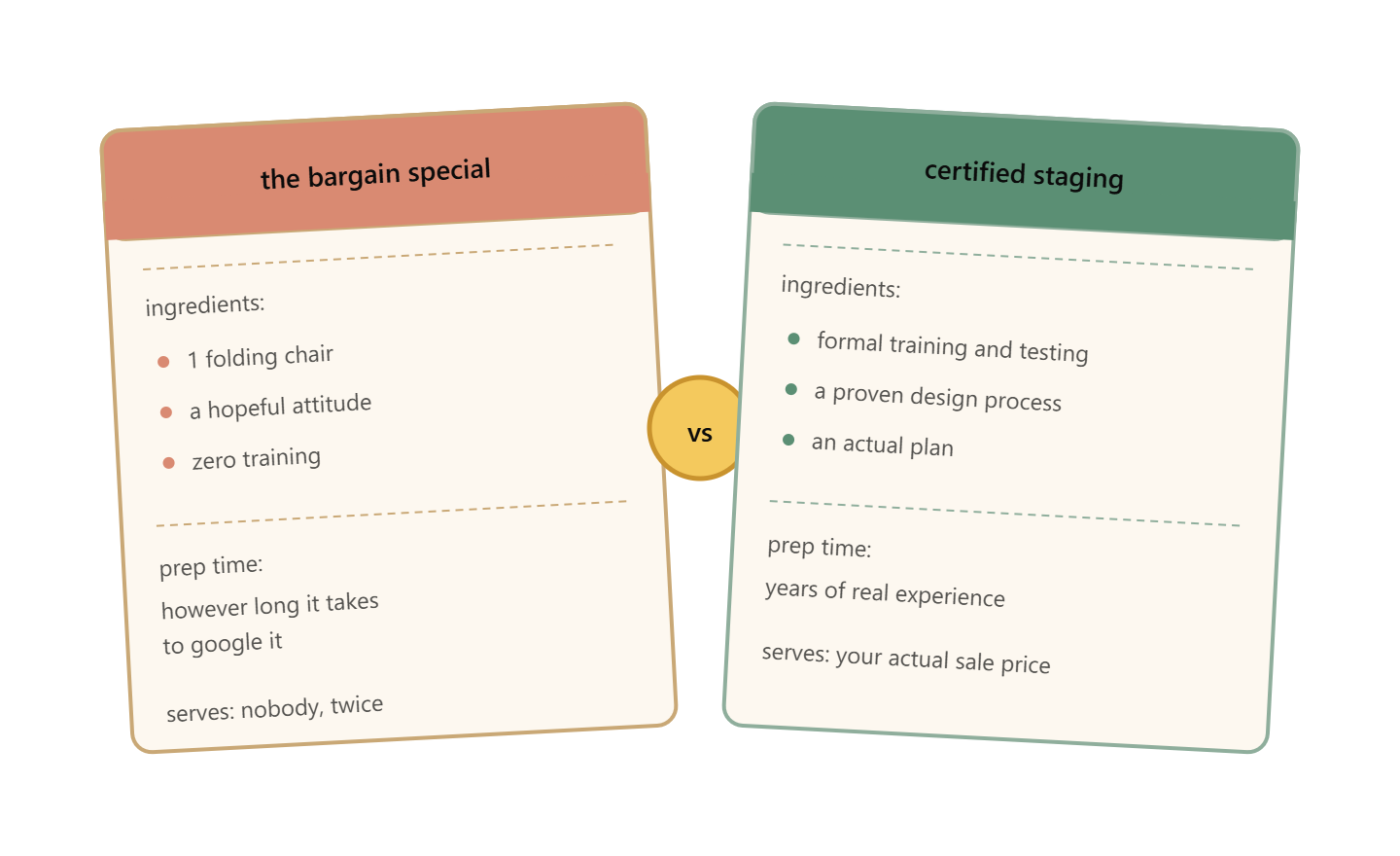
If you've ever shopped around for a home stager, you've probably noticed the quotes can vary wildly, sometimes by thousands of dollars for what looks like the same service on paper. Here's something that might explain why: home staging is an entirely unregulated industry. There's no license required, no governing body, no minimum standard. Anyone can print business cards that say "professional home stager" the same afternoon they decide to start, without ever having staged a real property or studied why staging works in the first place.
Not All Stagers Are Created Equal
That's not a knock on every low-cost stager out there. Some are genuinely talented and building real skill. But it does mean that when you're comparing quotes, you're not always comparing apples to apples. You could be comparing someone who's trained, tested, and proven their work against someone with minimal experience and no formal training.
What Certification Actually Requires
I'm a Certified Staging Professional® through CSP International, one of the longest-running staging education programs in the industry. They've been teaching the business of staging since 2001, and helped establish some of the first real standards, exams, and a professional code of ethics in an industry that previously had none.
Certification wasn't a weekend workshop. It meant:
- Live, instructor-led training — not a pre-recorded course you watch on your own time, but real interaction with an instructor and other students throughout.
- Staging an actual property on the market as part of the coursework. Not a mock exercise — a real listing, and the before-and-after results became part of my professional portfolio.
- A formal exam testing two different skill sets: the design side (room flow, which upgrades genuinely add resale value, color strategy) and the business side (pricing, contracts, how to run a consultation and actually close the work).
- Instructors who are staging business owners themselves — not just teaching theory. People who've built and run successful staging companies.
CSP International's program is also a two-tier system: the CSP® designation itself, plus a separate Residential Staging Expert® credential that has to be earned through documented in-field work, not just classroom hours. The organization is accredited through IAHSP (the International Association of Home Staging Professionals), and its founder has been affiliated with the Real Estate Staging Association since its earliest days.
Why This Actually Matters for Your Listing
None of this is just credentialing for its own sake. It shows up in the actual outcome. According to the National Association of Realtors, staged homes typically sell for 1 to 10% more than unstaged ones, and 81% of buyers' agents say staging makes it noticeably easier for buyers to picture themselves living in the space. With 97% of buyers starting their home search online, the first impression happens in photos — long before anyone walks through the door.
The gap between trained and untrained staging tends to show up exactly where it matters most:
- Whether a space actually reads well in photos. Not just "looks nice in person," but photographs in a way that translates online.
- Whether the design choices hold up under a real buyer walkthrough. Not just first impressions, but standing up to scrutiny.
- Whether the whole process runs smoothly. No surprises on install day, no scrambling, no guesswork.
The Bottom Line
Staging isn't regulated, so there's no shortcut to verifying who actually knows what they're doing. You have to ask. Certification isn't the only signal of skill, but it's a real one: proof of training, a tested design and business skill set, and a track record built on actual staged properties, not just good intentions.
Weighing Your Options?
If you're weighing options for an upcoming listing, I'm always happy to walk through what actually goes into a staging job — so you know exactly what you're paying for, either way. Contact HD Home Staging & Design to schedule a consultation.